Pressing Sources

Master tapes, mothers or vinyl

EMI (Australia) sourced and mastered The Beatles’ records in several ways, using imported UK mothers and master tapes as well as locally cut discs dubbed from vinyl. The methods varied considerably across singles, EPs and LPs—and often determined both the sound and the identifying features of Australian pressings.

As a subsidiary of EMI UK, EMI (Australia) received advance notice of forthcoming UK releases and could choose to import copies, manufacture them locally, or pass on them altogether — the latter generally only an option if the release had not charted strongly in the UK. EMI (Australia) primarily manufactured Beatles records locally, issuing them through its Parlophone label.

For most singles, EMI (Australia) took the cost-conscious approach and used imported vinyl discs as sources. This made commercial sense: it was far cheaper to dub from an existing record than to pay for tapes or metal parts, particularly at a time when audio quality on 7-inch releases was not considered paramount. These pressings can often be identified by their trimmed fades. Rather than fading naturally to silence, the fade is abruptly cut off—usually almost unnoticeably—in an apparent attempt to avoid the increased surface noise that becomes more apparent at the end of a disc.

The single 'Komm, Gib Mir Deine Hand'/'Sie Liebt Dich' was mastered from a copy of the German single.

Although 'The Ballad Of John And Yoko'/'Old Brown Shoe', 'Something'/'Come Together', and 'The Long And Winding Road'/'For You Blue' were not mixed in mono, they were nevertheless released in mono in Australia. Each was a fold-down from a stereo source: the UK single, Abbey Road LP, and Let It Be LP respectively. By contrast, 'Ob-La-Di, Ob-La-Da'/'While My Guitar Gently Weeps' was one of the few instances worldwide where the true mono mixes were used, being cut directly from the mono The Beatles LP.

Only two singles—'Hey Jude'/'Revolution' and 'Let It Be'/'You Know My Name (Look Up The Number)'—were pressed from mothers supplied by EMI UK. EMI (Australia) had made the decision to import mothers for these releases as they were concerned they would not be able to achieve a suitable result by mastering locally.

Original EPs were sourced from either vinyl discs or mono LP tapes where they existed in their library (for example, A Hard Day's Night, Beatles For Sale and Help! ). Side 1 of Requests was sourced from a mono copy of the US The Beatles' Second Album LP, as EMI (Australia) did not receive the required tracks from EMI UK in time for the planned release. Only five EPs—The Beatles' Hits, All My Loving, Nowhere Man, Magical Mystery Tour stereo, and Magical Mystery Tour mono—were initially pressed from mothers supplied by EMI UK.

In several instances, despite similar titles and even similar sleeves, the Australian track selections were subtly altered to accommodate the "extra" EPs EMI (Australia) had added to its catalogue. The EP discography lists the Australian EPs and their track selections.

For LPs, EMI (Australia) initially imported mothers from the UK, as this was considered more economical given the uncertainty around likely sales quantities. In 1964, once The Beatles had become more than just a household name, EMI (Australia) decided to obtain tape copies instead. This reduced the risk of delays if replacement metal parts were later required. It also provided greater flexibility for the increasing number of locally-conceived releases. As a result, A Hard Day's Night, Beatles For Sale, and Help! were cut locally from master tape copies supplied by EMI UK.

From Rubber Soul onward, EMI (Australia) reverted to importing mothers. The reason for this change is unclear. Unless EMI UK had advised that the master tapes were too delicate, or EMI (Australia) felt unable to do justice to them locally, there seems no obvious reason for the reversal. The major exception is Sgt. Pepper's Lonely Hearts Club Band, where the requirement to include the inner groove and high-pitched tone in 1967 would almost certainly have been beyond local cutting capability.

The stereo release of The Beatles was an interesting aberration. Whether for reasons of cost, availability, or difficulty obtaining UK parts, the stereo edition was pressed from mothers sourced from Capitol USA. The mono release, however, was pressed from mothers supplied by EMI UK. It is also worth noting that the New Zealand stereo release was likewise pressed from US mothers.

From the early 1970s, tapes increasingly became EMI (Australia)’s preferred source, allowing its own engineers to master records locally. Where EMI (Australia) instead obtained UK mastering, UK-cut lacquers generally replaced the mothers as preferred during the 1960s. These lacquers were processed locally to produce the metal parts required for pressing, preserving the UK mastering while allowing the remaining manufacturing stages to be undertaken in Australia.

This growing preference for tape sources reflected EMI (Australia)’s increasing confidence in its in-house mastering engineers. Source material also became less rigidly defined, with tapes arriving from the UK, the US and, in some cases, both. The clearest examples of US tape sources are the 1980 US-configured Rarities LP and the 1981 A Hard Day’s Night Original Motion Picture Sound Track release. Please visit the Production Master Tapes page for more information about tapes received by EMI (Australia).

For collectors, these arrangements have proved fortunate. They mean that much of the Australian Beatles LP catalogue was mastered in the UK—often cut by Harry Moss at EMI’s London studios—and is therefore essentially the same as the equivalent UK pressings. This has led many collectors to regard Australian Beatles pressings as sonically equivalent—and in some cases arguably superior—to their UK counterparts.

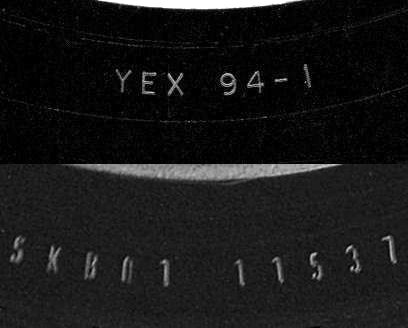
UK mothers and lacquers shipped to EMI (Australia) were machine-stamped with the matrix and lacquer numbers, such as "YEX 94-1". Unlike UK pressings, however, Australian pressings were generally not stamped with mother numbers. Nor did EMI (Australia) adopt the EMI UK stamper-code system, such as "GRAMOPHLTD". As a result, Australian pressings cannot be accurately dated simply by examining the deadwax.
Records cut locally usually had their matrix numbers etched by hand. From the 1970s to the early 1980s, however, cuts and recuts tended to have their matrix numbers pantograph engraved. These appear taller and narrower than the machine-stamped characters found on original UK pressings. By 1982, when most new recuts were being undertaken at Studios 301, matrix information was again generally being inscribed by hand. The accompanying enhanced image highlights the difference between UK machine stamping on Please Please Me and Australian pantograph engraving on Rock ’N’ Roll Music.
Example of UK machine stamping (top) and Australian pantograph engraving (bottom)
Identifying the engineer responsible for a particular Australian cut is considerably more difficult. EMI’s mastering engineers were originally expected to use the standard matrix stamp and were not permitted to add their initials—or even hand-scribe the details themselves. Consequently, a locally cut master might have been the work of senior mastering engineer Richard Mott, Bill Ramsay, Clive Lipman or another engineer, with nothing in the deadwax to identify who made it.

This began to change after the studio manager became aware that Don Bartley had been identifying his work while at RCA Australia. Initialling became more prevalent after Don moved to EMI (Australia), although its use remained haphazard and many masters continued to carry no engineer’s mark. Don and Leon Zervos at Studios 301 appear to have been the most conscientious, signing nearly everything they cut. The inconsistent practice means that many Australian masters can never be attributed to a particular engineer with certainty.

Taken together, these varied sources and manufacturing practices explain why Australian Beatles records can differ markedly even when their labels and sleeves appear almost identical. A pressing might preserve the original UK mastering, reflect the work of an Australian engineer cutting from tape, or reveal the limitations of a locally dubbed vinyl source. Identifying which method was used requires consideration of the matrix markings, deadwax characteristics and audible qualities of the record itself. These details form an important part of understanding—and appreciating—the distinctive history of The Beatles’ Australian catalogue.