Custom Pressings

The Cadbury radio special and EMI (Australia)’s Dial A Memory

Beyond the records issued through EMI (Australia)’s regular catalogue, a small number of unusual Beatles discs were manufactured in Australia for promotional, broadcasting and other specialised purposes. Two particularly fascinating examples appeared during the 1960s: a two-disc radio special produced for Cadbury Fry Pascall in 1964 and EMI (Australia)’s privately pressed Dial A Memory single in 1968. Never intended for conventional retail sale, these discs are now among the rarest Australian Beatles-related records.

The Cadbury radio special
During the early 1960s, the Australian confectionery company Cadbury Fry Pascall was highly active in the media, sponsoring radio programs and conducting numerous promotions aimed at contemporary audiences.

In early 1964, the Melbourne branch of Cadbury’s advertising agency, George Patterson, produced an extraordinary two-disc Beatles radio promotion. The records were cut at the Melbourne studios of Broadcast Exchange of Australia, better known as BEA.

With only three sets thought to survive, the two discs are arguably among the rarest Beatles-related records produced anywhere in the world.
The interview disc
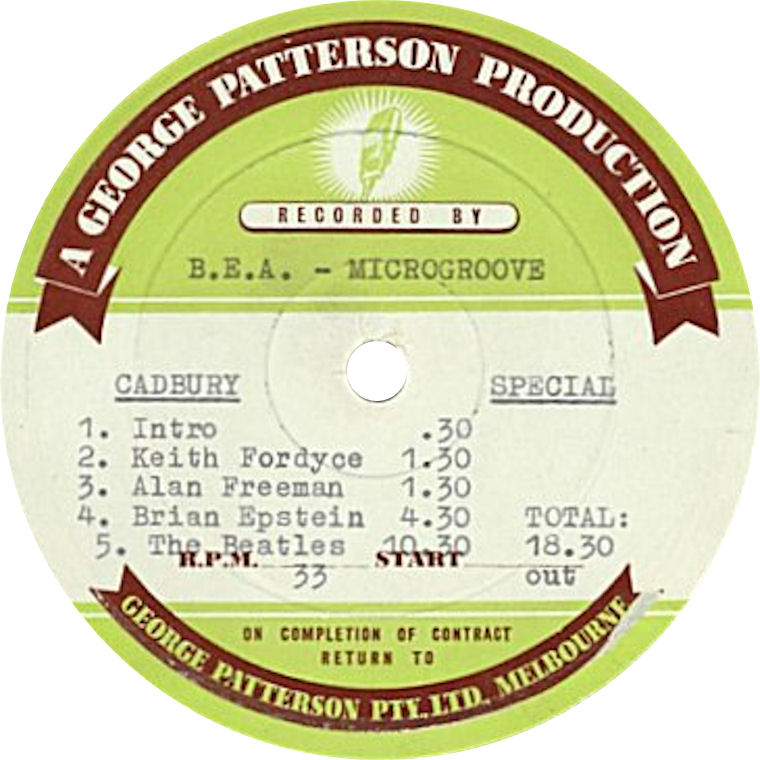
The first record is a one-sided disc featuring interviews with British broadcasters Keith Fordyce and Alan Freeman, Beatles' manager Brian Epstein and three members of The Beatles. Paul McCartney is absent from the group’s contribution.

In characteristically playful fashion, The Beatles joke with one another and perform brief a cappella renditions of 'On the Street Where You Live' and 'Tie Me Kangaroo Down, Sport'. They also improvise an original comic piece titled 'Don’t Shoot My Pet Dingo, Ringo'.
The first Cadbury disc is a one-sided recording containing interviews with Keith Fordyce, Alan Freeman, Brian Epstein and members of The Beatles

The music disc

The second record is a two-sided acetate combining Beatles recordings with hits by other contemporary artists.


Side one

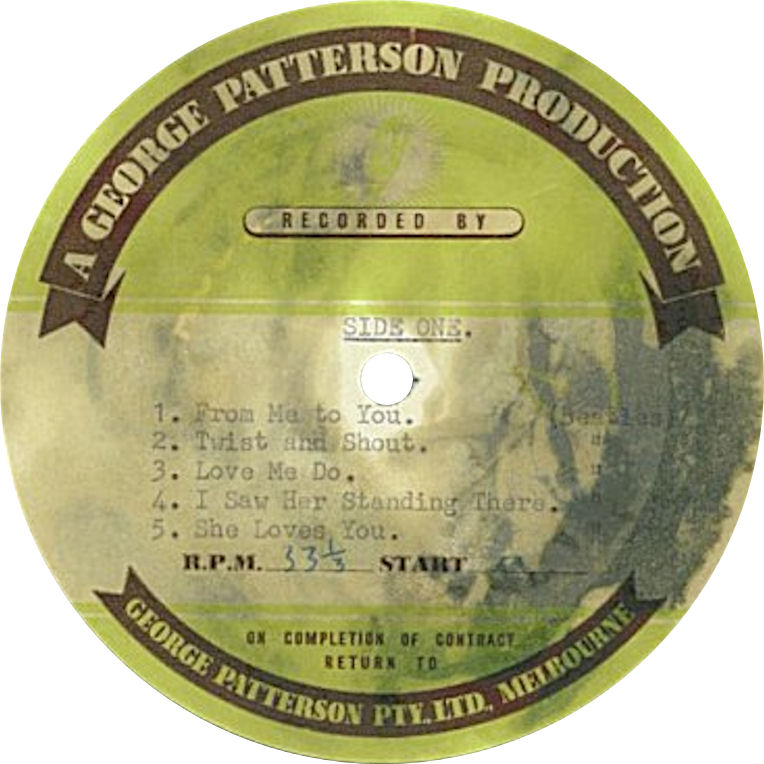
  • From Me to You — The Beatles
  • Twist and Shout — The Beatles
  • Love Me Do — The Beatles
  • I Saw Her Standing There — The Beatles
  • She Loves You — The Beatles
Side one of the second Cadbury disc, featuring five recordings by The Beatles

Side two

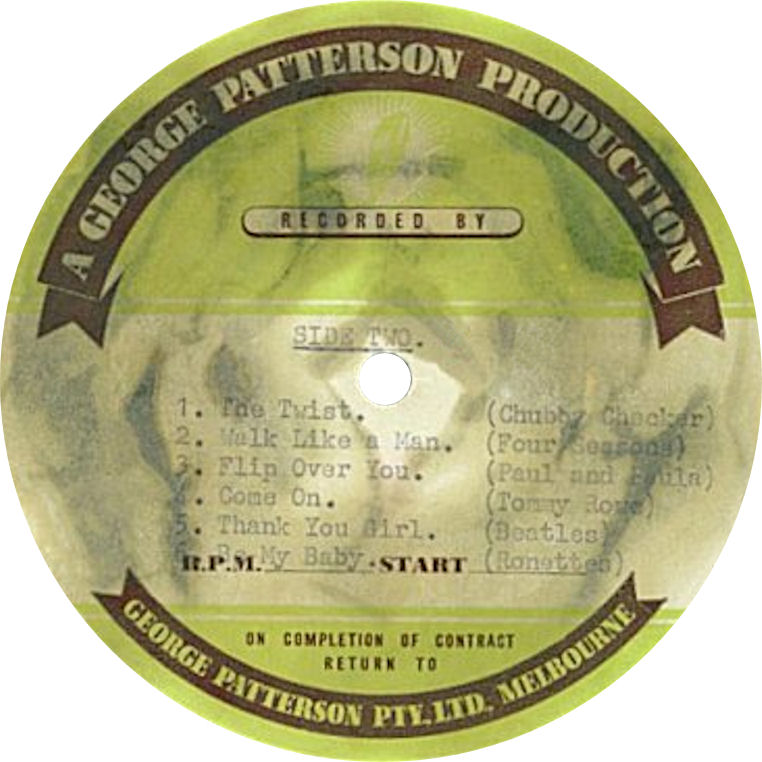
  • The Twist — Chubby Checker
  • Walk Like a Man — The Four Seasons
  • Flip Over You — Paul and Paula
  • Come On — Tommy Roe
  • Thank You Girl — The Beatles
  • Be My Baby — The Ronettes
Side two combines recordings by contemporary international artists along with The Beatles’ 'Thank You Girl'
EMI (Australia)’s custom pressing service
While the Cadbury radio special was cut independently at BEA, the second notable Beatles-related custom release was manufactured through EMI (Australia)’s own custom pressing service.

EMI (Australia) had been manufacturing records privately for individuals and outside organisations since at least 1942, when the first recordings by Slim Dusty were custom-manufactured and released on a private label. Slim reportedly paid £25 for 25 copies of his 78 rpm record.

From the early 1960s until mid-1986, EMI (Australia) operated a full-scale custom recording and pressing service. The service existed primarily to manufacture promotional records for organisations advertising products, services or public-awareness campaigns on radio. Customers included Coca-Cola, Sunoroid Glasses and Clairol, while records were also produced for campaigns such as Apex National Dental Health Week.

EMI (Australia) also manufactured records for independent artists and small or newly established record labels. Its custom service provided a comparatively inexpensive way to obtain a limited quantity of records from recordings made either at EMI’s Homebush studios or elsewhere. Artists could then send these records to radio stations and record companies in the hope of attracting airplay, distribution or a recording contract.

During the 1960s and 1970s, promotional recordings accounted for much of EMI’s custom-pressing work. By 1981, however, the emphasis had shifted increasingly towards independent releases. Sydney’s Studios 301 even extended the service into distribution. Custom pressings could be listed in EMI (Australia)’s official catalogue and ordered through record shops without the artist or label having a conventional recording agreement with EMI.

For emerging performers who might otherwise have been selling cassette recordings from the boot of a car, the service provided valuable access to professional record manufacture and retail distribution.

Dial A Memory
In early 1969, EMI (Australia)’s custom division manufactured a series of singles apparently connected with a radio segment or promotional service called Dial A Memory. The series featured recordings that were otherwise no longer available in the current singles catalogue.

One of the discs paired the Beatles’ 'Please Please Me' with a recording by Australian bass-baritone Peter Dawson. The Beatles song had been deleted from EMI (Australia)’s singles catalogue in December 1967, making its reappearance on the custom pressing particularly unusual.

This was not simply a repressing of the commercially released single. The recording of 'Please Please Me' was preceded by an EMI (Australia) marketing voiceover, evidently prepared for its use in the Dial A Memory series.

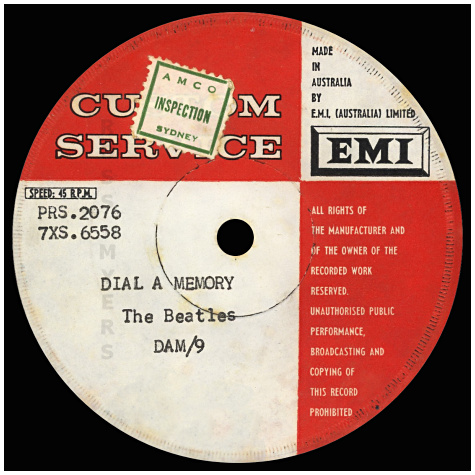
The discs carried plainly typed "CUSTOM SERVICE" labels rather than EMI (Australia)’s standard commercially printed designs. This suggests that only a very small number of copies was manufactured, probably for restricted broadcasting or promotional use.
The EMI (Australia) custom pressing for Dial A Memory, featuring the Beatles’ 'Please Please Me' on one side and a recording by Peter Dawson on the other.
Rare records with a specific purpose
The Cadbury radio special and Dial A Memory were separate productions manufactured by different organisations for different purposes. What connects them is their existence outside The Beatles’ regular Australian record catalogue. Neither was intended for sale through conventional record shops, and both appear to have been made in exceptionally limited quantities.

The surviving discs reveal a largely hidden aspect of Australia’s record industry: the use of specially manufactured records to connect popular music with broadcasting, advertising and corporate promotion. Their inclusion of Beatles recordings—and, in the case of the Cadbury production, unusual spoken and musical material—has transformed these once-functional promotional discs into historically important and highly prized artefacts.