Why Festival Records?
Outsourcing was necessary because EMI (Australia) did not have the capability to manufacture coloured vinyl locally. Although Beatles coloured vinyl had been pressed overseas as early as 1978, Australians would not see domestically pressed Beatles coloured vinyl until 1987.
Part of the delay stemmed from EMI (Australia)'s reluctance to invest in what it regarded as the "gimmick" of coloured vinyl. The company considered coloured pressings too noisy and potentially a compromise of its high-quality standards. When it decided in mid-1987 to celebrate the 20th anniversary of Sgt. Pepper's Lonely Hearts Club Band with a limited red-vinyl edition, it therefore turned to the local plant with extensive experience in the process: Festival Records.
Festival Records was Australia's oldest and largest independent record label, having been formed in Sydney in October 1952. By the late 1970s it was already experimenting with 12-inch coloured vinyl and picture discs. Warren Barnett, who spent 28 years with Festival, later recalled that the company's coloured-vinyl capability was precisely why EMI came to Festival when it wanted to manufacture such releases: EMI (Australia) simply could not do it itself. Festival was also producing picture discs for much the same reason.
Sgt. Pepper's goes red
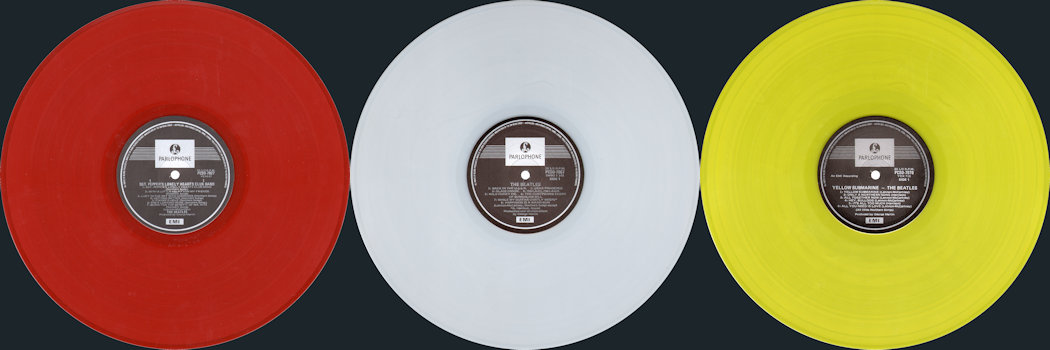
At EMI (Australia)'s request, Festival pressed just over 9,000 copies of Sgt. Pepper's Lonely Hearts Club Band on red vinyl, although early copies were actually closer to pink than red.
Unlike the later coloured editions of The Beatles and Yellow Submarine, Festival also mastered the Sgt. Pepper's release.
Warren created new half-speed masters for the album. He recalled that the 15ips tapes initially supplied by EMI (Australia) were several generations removed from the original and unsuitable for the project, prompting him to send a Telex to his friend Ken Townsend, then studio manager at Abbey Road. According to Warren, Ken arranged for new 30ips tapes to be sent from EMI UK, which arrived at Festival within a week. However, surviving evidence suggests that the tapes Festival ultimately received may not have been newly prepared copies from the original masters, but the same 30ips tapes previously used by Don Bartley for the 1983 AUDIOPHILE reissue.
The resulting limited edition appeared on 1 June 1987 and marked Australia's first locally pressed coloured-vinyl Beatles album.
The Beatles and Yellow Submarine
EMI (Australia)'s experiment did not stop with Sgt. Pepper's. Two months later it followed with two other obvious candidates for coloured vinyl: The Beatles—the "White Album"—and Yellow Submarine. EMI (Australia) requested 2,000 copies of each, nominally on white and yellow vinyl respectively.
Although Festival pressed both albums, this time it did not master them. Their masters had been cut by Allan Parsons at EMI's Homebush plant from digital tapes created from the existing analogue master-tape copies, with Festival manufacturing the finished records from metal parts supplied by EMI (Australia). Please visit the dedicated album pages for more information.
It was the actual manufacture of the supposedly white vinyl that caused the greatest difficulty.
Why is the "White" Album grey?
One of the most obvious peculiarities of the Australian coloured-vinyl White Album is that it isn't really white.
Copies generally range through shades of pale grey, sometimes with variations between individual discs. For years this has simply been accepted as a characteristic of the Australian pressing. The explanation lies in the difficulties Festival encountered in trying to manufacture the album on the pure, opaque-white vinyl originally specified by EMI (Australia).
Festival's vinyl compound was supplied by Nylex, which provided batches specifically for the company from its Botany premises. To achieve the required pure-white appearance, titanium colouring was added to the vinyl compound.
When Festival produced its first test pressings from the mothers supplied by EMI (Australia), however, the records were excessively noisy. The problem was the amount of titanium required to make the vinyl genuinely white. The concentration necessary to achieve the desired opaque-white appearance adversely affected the playback quality.
The only practical solution was to reduce the amount of titanium.
What followed was a lengthy series of experiments involving Festival, EMI (Australia) and Nylex as they attempted to find a formulation that would remain as close as possible to the intended white appearance without producing unacceptable surface noise.
Warren remembered the process continuing for around a month:
"We had the people from Nylex come over, we had sample bags that they had done especially for us — less titanium, a little more, a little less. We pressed it all, and we played it all. EMI came over. It was a great to-do."
Each change involved a trade-off. More titanium produced a whiter record but increased the unwanted noise; reducing the titanium improved the playback quality but progressively moved the colour away from the pure white EMI (Australia) had originally specified.
Eventually, a workable compromise was found. Enough titanium was removed to bring the noise down to an acceptable level, but by then there was insufficient white colouring in the compound to produce the intended opaque-white appearance. The smaller quantity that remained merely lightened the underlying vinyl.
The result was the familiar light-grey vinyl found on the Australian release.
The colour was therefore not a deliberate aesthetic choice, EMI (Australia) intended the records to be pure white. Grey was simply the colour of the formulation that ultimately provided the best balance between appearance and acceptable sound quality after weeks of experimentation.
Warren summed up the outcome simply: that was how Australia ended up with the "grey album".
The Australian White Album therefore preserves in its appearance a small piece of manufacturing history. What can look today like an unsuccessful attempt at white vinyl was, in fact, the physical result of the production problem itself: the amount of titanium needed to make the record truly white also made it too noisy, while reducing that titanium sufficiently to improve the sound inevitably turned the finished vinyl grey.
Packaging the coloured-vinyl editions
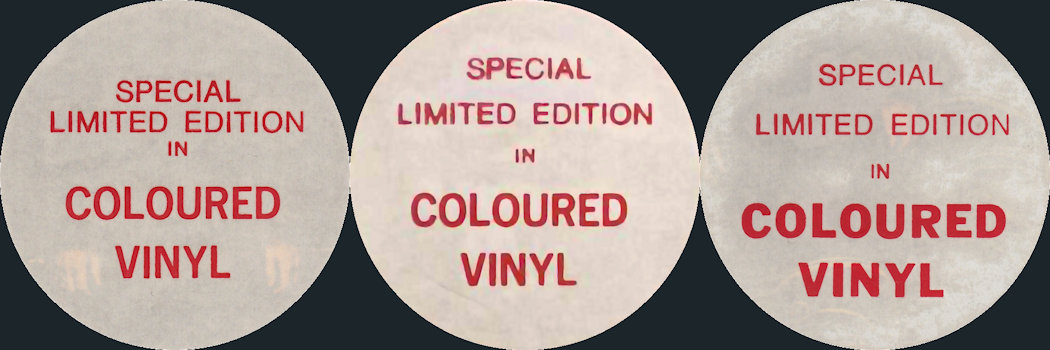
All three coloured-vinyl releases were pressed with standard EMI labels and housed in standard EMI sleeves. Rather than manufacturing dedicated sleeves identifying them as coloured editions, EMI (Australia) distinguished the records with a sticker attached to the front cover stating "SPECIAL LIMITED EDITION IN COLOURED VINYL".
Several variations of the sticker exist, with three of the more common versions shown below.
The differences provide another useful means of identifying and dating original Australian copies.
A warning about coloured Abbey Road pressings
Collectors should be wary of Australian-looking coloured-vinyl Beatles records that fall outside these documented releases.
Around July 2010, various coloured-vinyl and picture-disc copies of Abbey Road, purportedly pressed in Australia, began appearing on online auction sites in reasonably large quantities.
Abbey Road was never officially pressed in Australia on coloured vinyl or as a picture disc.
These copies are fakes and should not be confused with EMI (Australia)'s genuine 1987 Festival-manufactured coloured-vinyl releases.