The beginnings of local manufacture
By the mid-1920s, Australian demand for gramophone records had grown beyond what could reliably be supplied from overseas. In response, Britain’s Gramophone Company Ltd opened a 40,000-square-foot gramophone and record factory at Erskineville, Sydney, on 18 January 1926. Employing approximately 400 staff, together with a manager and twelve departmental heads brought from Britain, the plant manufactured His Master’s Voice gramophones and records for the Australian and New Zealand markets.
Nine months later, on 14 October 1926, rival Columbia Graphophone Company Ltd officially opened its own Australian factory at Homebush, Sydney. Operated through Columbia Graphophone (Australia) Ltd, the new 50,000-square-foot plant employed approximately 350 people.
The formation of EMI
On 20 March 1931, amid the economic pressures of the Great Depression, the Gramophone Company Ltd and Columbia Graphophone Company Ltd—including its subsidiary, the Parlophone Company Ltd—merged in Britain to form Electric and Musical Industries Ltd, better known as EMI.
Their Australian operations were brought under a single administrative structure as the “associated manufacturers”. Record production was consolidated at Columbia’s Homebush factory from July 1931, establishing the site that would remain at the centre of EMI’s Australian manufacturing operations for almost six decades.
EMI (Australia) was formed as a proprietary company in 1948 to assume the activities previously conducted by the Australian branches of the British companies. Its headquarters were housed in the eight-storey Emitron House at 301 Castlereagh Street, Sydney. The company became a public company in May 1957.
By 1963, EMI (Australia) manufactured and distributed an extensive range of products, including televisions, radios, radiograms, car radios, domestic electrical appliances and, of course, gramophone records. Its records appeared on the company’s principal HMV, Columbia and Parlophone labels, while the Homebush factory also manufactured records on behalf of Britain’s Decca Records.
The Homebush factory
Manufacturing and distribution were centred at Homebush, where the original factory was progressively extended as EMI (Australia)’s activities expanded. The site remained EMI (Australia)’s principal manufacturing and distribution centre until it closed in November 1990, almost 65 years after opening.
The plant originally contained twenty of the most advanced record presses then available. Imported from Britain and installed by British engineers, they were collectively capable of producing approximately eleven million records each year.
EMI (Australia) continued to draw upon British expertise and equipment throughout its history. By the time The Beatles were filling Australian homes with their music in the 1960s, the Homebush factory was using pressing equipment similar to that employed at EMI’s plant at Hayes, Middlesex.
Releasing The Beatles in Australia
As a subsidiary of EMI in Britain, EMI (Australia) received advance notice of forthcoming British releases. It could then choose to import the finished product, manufacture an Australian edition or decline the release altogether—the last option generally being available only when a title had not charted strongly in Britain.
Most Beatles records were manufactured locally and released on EMI’s Parlophone label. Alongside the principal British catalogue, EMI (Australia) also devised numerous releases specifically for the local market. The company quickly discovered that, where The Beatles were concerned, more releases were better than fewer.
Between 1963 and 1970, EMI (Australia) released 30 singles, including 18 double A-sides, together with 18 EPs and 17 LPs. Over the same period, EMI in Britain released 22 singles, 13 EPs and 13 LPs.
Australian catalogue numbers
British Parlophone LPs adopted for Australian release generally retained their original catalogue numbers, with the Australian country code “O” added to the mono or stereo prefix. For example, the British catalogue number PMC 1202 became PMCO 1202 in Australia.
Albums issued locally that were not part of the British Parlophone catalogue were assigned numbers from a separate Australian series beginning at PMCO 7500 for mono and PCSO 7500 for stereo.
The same principle applied to EPs. British Parlophone EPs released in Australia retained their original numbers, with an “O” added to the GEP prefix. Locally compiled EPs—including British titles with modified track listings—were allocated numbers from an Australian series beginning at GEPO 70001.
Australian Parlophone singles originally used catalogue numbers in the A8000 series. From A8083, numbers ending in “3” were either allocated to, or reserved for, The Beatles.
In March 1968, EMI (Australia) replaced the separate numbering systems used by its house and distributed labels with a unified catalogue beginning at 8301. The 8000 series was selected because Parlophone’s existing catalogue—the highest series then in use—had already reached the low 8000s. ‘Lady Madonna’/‘The Inner Light’ was the final Parlophone single issued under the earlier numbering system.
Mono, stereo and other formats
EMI (Australia) manufactured LPs in both mono and stereo throughout most of the 1960s. As demand for mono records declined, the company deleted mono editions of albums for which stereo alternatives existed in June 1969. By then, the mono editions of The Beatles and Yellow Submarine had sold only approximately 5,000 and 1,300 copies respectively.
Locally manufactured pre-recorded cassettes followed in 1970, with 8-track cartridges introduced around the middle of 1972. All Beatles LPs were subsequently released in both formats (although the Yellow Submarine 8-track cartridge was available through import only).
As in Britain, cassette and 8-track editions were not necessarily mastered from the same tapes as their vinyl counterparts. It was therefore possible—and quite likely—for different formats of the same album to have been prepared from different sets of tapes.
Further information about these releases can be found in the 'Other Formats' section.
Inside the Homebush factory
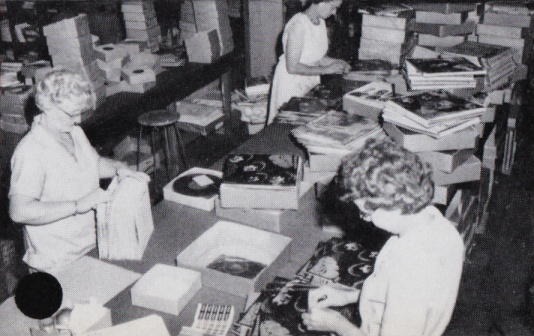
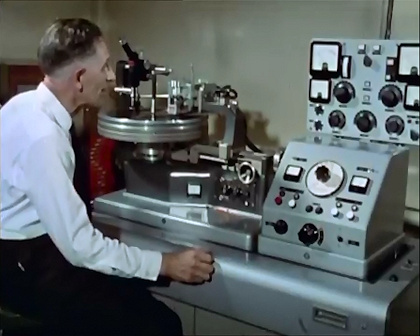
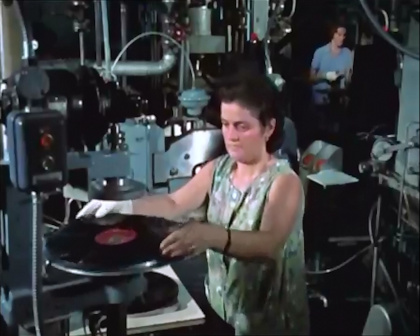
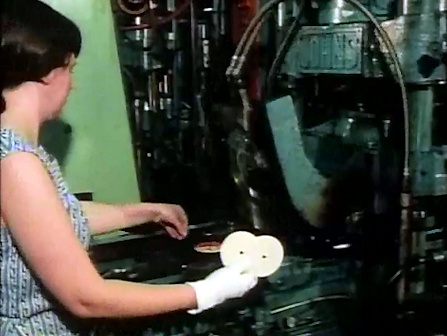
Manufacturing a record involved much more than pressing vinyl. Mastering engineers prepared the lacquer masters from which metal pressing components were produced; factory employees operated the presses; printers supplied labels and sleeves; and assembly staff matched the finished records with their packaging.
The following photographs offer a glimpse of the people, equipment and working practices behind EMI (Australia)’s records.